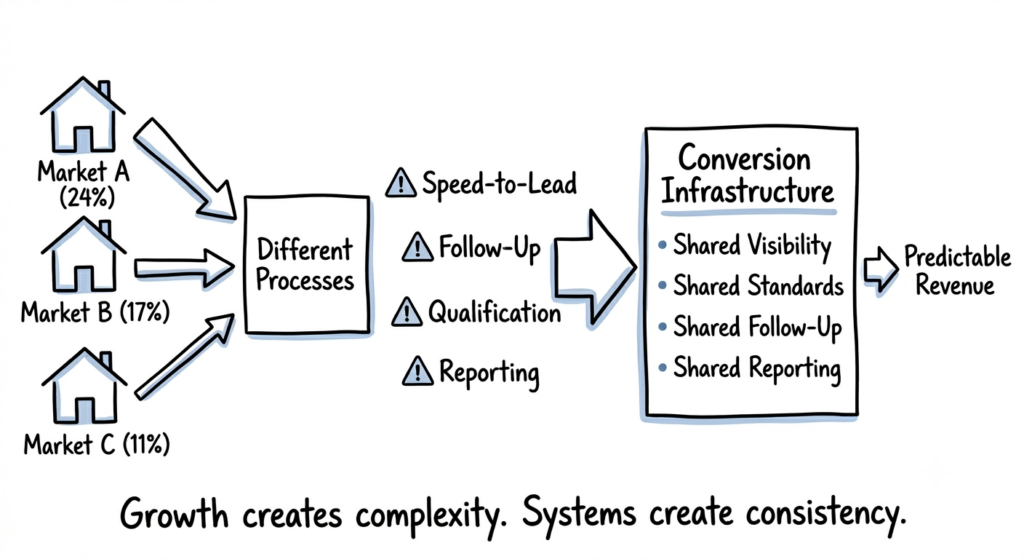
Growth Doesn’t Create Consistency. Systems Do.

What Enterprise Home Improvement Operators Learn When They Expand
Growth is exciting.
A new market. A new branch. A new acquisition.
On paper, expansion often looks straightforward: more locations should create more opportunities, more appointments, and more revenue.
But operators who have scaled beyond a handful of locations know the reality is more complicated.
Because growth doesn’t automatically create consistency.
In many cases, it exposes the lack of it.
The Hidden Challenge of Expansion
Most executive teams expect integration challenges after growth.
Different CRMs.
Different reporting structures.
Different teams.
What they don’t always expect is how quickly conversion performance begins to vary across locations.
One market consistently fills calendars.
Another struggles to book appointments.
A third generates plenty of leads but produces fewer sit appointments than expected.
The result is a question many operators eventually ask:
“If we’re using the same brand, same marketing, and similar lead sources, why are the outcomes so different?”
The answer is rarely lead volume.
More often, it’s execution.
Why One Market Books More Appointments Than Another
The home improvement industry often focuses on demand generation.
But once a lead arrives, performance becomes operational.
Response speed.
Call handling.
Qualification.
Follow-up.
Appointment confirmation.
Small differences in these areas create surprisingly large performance gaps.
At Convertros, we’ve seen the same lead source perform dramatically differently depending on the operation receiving it. In fact, one internal analysis showed identical lead sources producing conversion outcomes that varied significantly despite being worked by the same organization. The lead source wasn’t the variable. The process was.
That’s why the best operators stop asking:
“How many leads did we get?”
And start asking:
“What happened after they arrived?”
The Revenue Leakage Leaders Can’t Always See
Conversion inconsistency rarely appears as a major operational failure.
Instead, it hides inside small daily decisions.
One branch calls leads within 30 seconds.
Another responds in fifteen minutes.
One team follows up seven times.
Another stops after two attempts.
One location prioritizes appointment quality.
Another prioritizes appointment volume.
Individually, these differences seem minor.
Collectively, they create meaningful revenue leakage.
The challenge becomes even greater as organizations expand into multiple markets, brands, or territories.
Visibility becomes harder.
Standardization becomes harder.
Accountability becomes harder.
And yet the cost of inconsistency grows with every additional location.
Three Questions Every Growth-Focused Operator Should Ask
Before adding another market, territory, or acquisition, leaders should understand how consistent their conversion system really is.
1. Are all locations working leads at the same speed?
Speed-to-lead remains one of the strongest predictors of conversion performance.
Convertros data from more than 18,000 leads showed a six-point difference in booking performance based solely on response speed. Nothing else changed. Not the lead source. Not the people. Only the clock.
2. Do all teams follow the same qualification standards?
An appointment on the calendar isn’t always a quality opportunity.
The strongest operators define exactly what qualifies as a booked appointment and ensure every market follows the same standard.
Without shared definitions, comparing performance across locations becomes almost impossible.
3. Can leadership see conversion performance across markets?
Many organizations have visibility into marketing spend.
Fewer have visibility into what happens after the lead arrives.
Without shared reporting, leaders often discover performance issues months after revenue has already been lost.
Consistency requires visibility.
Visibility requires systems.
The Conversion Infrastructure Advantage
The companies creating the most predictable growth today are not necessarily generating more demand.
They’re creating stronger systems around the demand they already have.
That means standardizing:
- Response speed
- Qualification frameworks
- Follow-up processes
- Reporting visibility
- Appointment quality standards
The goal isn’t to eliminate local flexibility.
The goal is to ensure every market operates from the same playbook.
This is where conversion infrastructure becomes a competitive advantage.
As lead costs continue to rise and competition increases, revenue efficiency becomes just as important as revenue growth. Convertros describes this shift as the emergence of conversion infrastructure as a revenue-efficiency layer rather than an operational nice-to-have.
The organizations that scale successfully understand a simple truth:
Growth creates complexity.
Systems create consistency.
And consistency is what ultimately creates predictable revenue.