Improve Home Improvement Lead Conversion
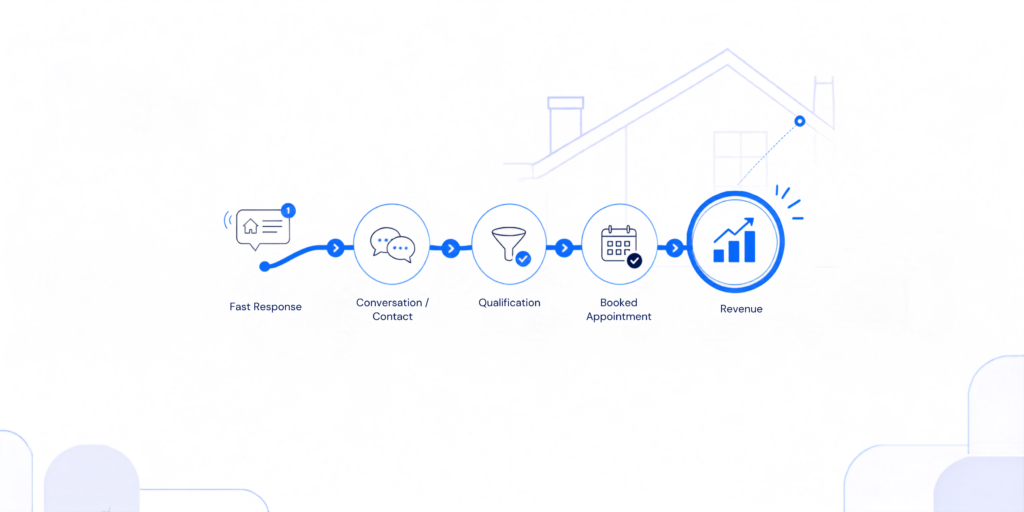
More leads won’t fix weak conversion. The bigger opportunity is improving what happens after the lead comes in.
Home improvement companies can improve lead conversion by focusing on six areas: response speed, contact strategy, qualification, follow-up, appointment setting, and measurement.
Generating more demand does not automatically create more revenue. If existing leads are not being converted consistently, increasing lead volume can simply make the leakage more expensive.
Key takeaways
- Lead volume alone does not determine revenue performance.
- Speed and follow-up strongly influence how much inbound demand turns into real conversations.
- Conversion should be measured across the full journey, not with one blended rate.
- The first step is identifying where leads are actually being lost.
Start by looking beyond lead volume
A useful conversion funnel looks like this:
Lead → Contact → Qualified Conversation → Appointment → Sit → Sale → Revenue
If performance is weak, the goal is not simply to “improve conversion.” First identify where the biggest drop is happening.
High lead volume with a low contact rate signals a different problem than a strong contact rate with weak appointment-setting performance.
Understanding that difference makes it easier to fix the right part of the process.
Five areas to examine
1. Response speed
High-intent homeowners often contact multiple companies.
The longer a lead waits, the more opportunity there is for another company to start the conversation first.
Review how quickly new inbound leads receive a response, including after hours and during periods of high lead volume.
2. Contact strategy
A missed first call should not automatically become a lost lead.
A consistent follow-up strategy gives viable opportunities more chances to convert. That may include additional calls, texts, or other appropriate channels depending on the lead and your process.
The goal is not simply more attempts. It is creating a consistent contact process instead of relying on one interaction.
3. Qualification
Good conversion is not just about booking more appointments.
Teams need to determine whether the homeowner and project are a real fit based on criteria such as:
- project type
- service area
- timing
- homeowner intent
- other business-specific qualification requirements
A higher appointment rate only matters if the appointments are worth having.
4. Appointment setting
Once a homeowner is qualified, the conversation should naturally move toward a clear next step.
Reduce unnecessary friction between qualification and scheduling, and make sure the homeowner understands what happens next.
The objective is simple: turn a qualified conversation into a clear, confirmed appointment.
5. Measurement
A single blended conversion rate can hide important problems.
Track performance by variables such as:
- lead source
- campaign
- market
- branch
- vertical
- time of day
This makes it easier to see where performance is strong, where leads are leaking, and which areas deserve attention first.
The bigger question
Before increasing lead spend, ask:
Are we getting everything we can from the demand we’re already paying for?
For many home improvement companies, improving the answer to that question can be one of the fastest ways to generate more revenue from existing marketing investment.
More demand still matters. But better conversion makes every additional marketing dollar work harder.
Frequently asked questions
What is lead conversion?
Lead conversion is the process of moving an inbound lead through the steps required to become a customer. In home improvement, that typically includes contact, qualification, appointment setting, the sales appointment, and ultimately the sale.
How quickly should you contact an inbound lead?
Generally, the sooner the better. High-intent homeowners may contact several providers, so delays create more opportunity for competitors to start the conversation first.
Why aren’t my inbound leads converting?
Common causes include slow response times, inconsistent follow-up, low contact rates, poor qualification, friction during appointment setting, or weaknesses at later stages of the sales process.
What’s the difference between lead generation and lead conversion?
Lead generation creates demand. Lead conversion determines how much of that demand becomes revenue.
Generating more leads increases opportunity. Improving conversion increases the value of the leads you already have.
Convertros turns inbound home improvement demand into qualified, booked appointments, helping operators strengthen the conversion layer between marketing and sales.