Where Multi-Market Growth Breaks First

Where does conversion actually begin to break and why do similar leads produce different outcomes?
Series: The Conversion Infrastructure Series | Part 3 of 4
Most Growth Problems Aren’t Really Growth Problems
Expanding into a new market should create more opportunities.
More territories.
More brands.
More marketing.
More leads.
But for many home improvement operators, growth produces something unexpected:
More inconsistency.
On paper, the business appears healthy.
Lead volume is increasing.
Marketing continues generating demand.
Sales calendars remain active.
Yet revenue begins to vary significantly across markets.
The question executives eventually ask is:
“If we’re generating similar demand everywhere, why are some locations consistently outperforming others?”
The answer often isn’t marketing.
It’s the handoff.
The Lead-to-Appointment Handoff Is Where Growth Gets Tested
Every lead follows the same journey.
Someone fills out a form.
Calls the business.
Requests an estimate.
Clicks on an advertisement.
From that moment forward, every operational decision affects whether that opportunity becomes revenue.
Was the lead routed correctly?
Did someone respond immediately?
Was the conversation handled consistently?
Did follow-up continue after the first attempt?
Was the appointment confirmed?
Every one of these moments either builds momentum or introduces friction.
Most companies don’t lose revenue because of one catastrophic mistake.
They lose it through dozens of small inconsistencies repeated thousands of times.
As Stirling Cox, CEO & Co-Founder of Convertros, explains:
“The lead-to-appointment handoff is where small operational differences become measurable revenue differences.”
Five Places Revenue Leakage Begins
Revenue leakage rarely starts with the sale.
It starts much earlier.
Across enterprise home improvement organizations, the same operational patterns appear repeatedly.
1. Slow First Contact
The first few minutes matter more than most dashboards reveal.
A fast response isn’t simply good customer service.
It’s often the difference between speaking with the homeowner or speaking with voicemail.
2. Inconsistent Qualification
Two associates receive similar opportunities.
One books the appointment.
The other doesn’t.
The difference often isn’t the lead.
It’s how consistently qualification standards are applied.
Without shared definitions, every branch begins operating differently.
3. Follow-Up That Ends Too Soon
Very few homeowners make purchasing decisions after a single conversation.
Some need another call.
Others need additional information.
Some simply get busy.
Organizations with disciplined follow-up continue creating opportunities long after others have stopped trying.
4. Weak Appointment Confirmation
Booking the appointment isn’t the finish line.
Held appointments create revenue opportunities.
Strong confirmation processes reduce no-shows and create a better homeowner experience before the sales representative evenarrives.
5. Limited Visibility Across Markets
This may be the most expensive failure point of all.
Leadership sees the results.
But they don’t always see the process producing those results.
Without shared reporting, operational differences remain hidden until revenue starts declining.
Why Hiring More People Doesn’t Solve the Problem
When growth accelerates, many organizations naturally hire.
More appointment setters.
More customer service representatives.
More managers.
But additional people don’t automatically create additional consistency.
Without shared playbooks, training, reporting, and accountability, expansion simply multiplies existing variation.
Growth amplifies the operating system that’s already in place.
It doesn’t replace it.
As Stirling often says:
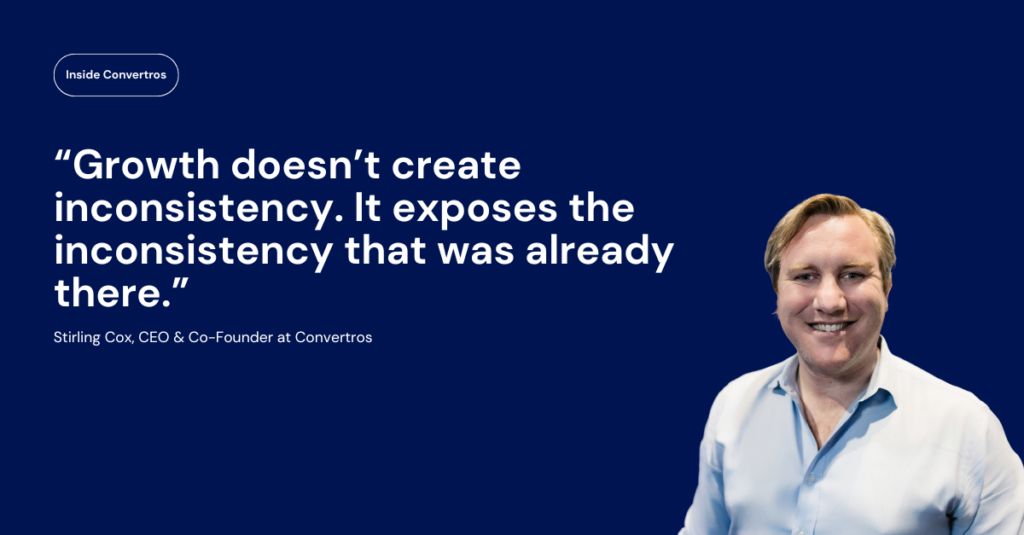
What Strong Conversion Infrastructure Looks Like
The highest-performing operators don’t try to make every location identical.
They create consistency around the moments that matter most.
That means standardizing:
- how leads are routed
- response expectations
- qualification criteria
- follow-up cadence
- appointment confirmation
- performance reporting
Local teams still have flexibility.
But leadership gains confidence that every homeowner receives the same level of attention regardless of location.
That’s what creates predictable appointment performance across brands, branches, and markets.
Three Questions Every Operator Should Ask
Before investing in another acquisition, market, or marketing campaign, ask three simple questions:
Are all locations responding to new leads with the same urgency?
Would every team qualify the same homeowner in the same way?
Can leadership clearly see where appointments are being won—or lost?
If the answer to any of those questions is “no,” the business may not have a demand problem.
It may have a conversion consistency problem.
The Executive Takeaway
Marketing creates opportunities. Operations convert them. Growth depends on both.
The organizations creating the strongest long-term performance understand that lead generation is only the beginning of the customer journey.
The real competitive advantage comes from building a conversion system that performs consistently across every market, every team, and every interaction.
Because every successful sale begins with a successful handoff.