More Tools, More AI. So Why Is Performance Still Hard?
If there’s one thing that stood out across conversations at LeadsCon this year, it’s how quickly the industry is evolving.
New platforms.
New AI-driven solutions.
New systems promising more automation and efficiency.
Innovation is everywhere.
And yet, for many companies, performance still feels difficult to sustain.
In this series, we explored how the industry is shifting away from simply generating more leads and toward improving what happens after the lead comes in. The natural next question is: if companies now have more technology than ever before, why are so many still struggling to create predictable outcomes?
The answer is complexity.
The Industry Isn’t Just Evolving. It’s Getting Harder
Technology is improving rapidly, but so are the operational demands placed on home improvement companies.
As Stirling Cox, CEO & Co-Founder of Convertros, explains:
Everything is getting more complex and more expensive. Leads cost more, regulations are increasing, and companies need stronger infrastructure just to maintain performance.”
That change is affecting every stage of the funnel.
It’s no longer enough to simply generate leads, respond quickly, or close deals. Companies now need tighter compliance, better visibility into performance, stronger coordination between teams, and more consistency across the entire customer journey.
The margin for operational inefficiency is shrinking.
AI Is Accelerating the Industry and the Complexity
AI is already reshaping how companies handle inbound opportunities.
From lead routing and call handling to automation and performance optimization, AI is becoming part of the operational foundation of modern revenue teams.
As Noel Land, Sales & Partnerships Manager at Convertros, shared:
AI is helping the industry in many ways now beyond basics.”
But AI is not simplifying operations on its own.
In many cases, it is increasing the number of systems, workflows, and decisions companies need to manage effectively.
More tools create more opportunities but they also create more moving parts.
And that’s where many organizations begin to struggle.
Why Some Companies Are Pulling Ahead
The companies creating the strongest results today are not necessarily the ones adopting the most technology.
They are the ones integrating systems effectively, aligning teams around shared processes, and executing consistently across the funnel.
Nasima Assad, Enterprise Lead at Convertros, highlighted this shift clearly:
There’s a growing awareness that volume alone isn’t enough, and more teams are actively looking for better ways to improve outcomes.”
That awareness matters because many organizations are now recognizing that fragmented operations create fragmented performance.
- Disconnected systems.
- Incomplete data.
- Inconsistent follow-up.
- Lack of visibility across teams.
These issues compound quickly, especially at scale.
The companies pulling ahead are solving for coordination, not just automation.
The Real Competitive Advantage
As the industry becomes more technology-driven, operational maturity is becoming a larger differentiator.
The organizations winning today are building systems where:
- data flows across teams
- customer communication stays consistent
- performance is measured holistically
- technology supports execution instead of complicating it
Because better tools alone do not guarantee better outcomes.
Better systems do.
Summary
Across this series, one theme remained consistent: the home improvement industry is moving toward a more operationally mature model of growth.
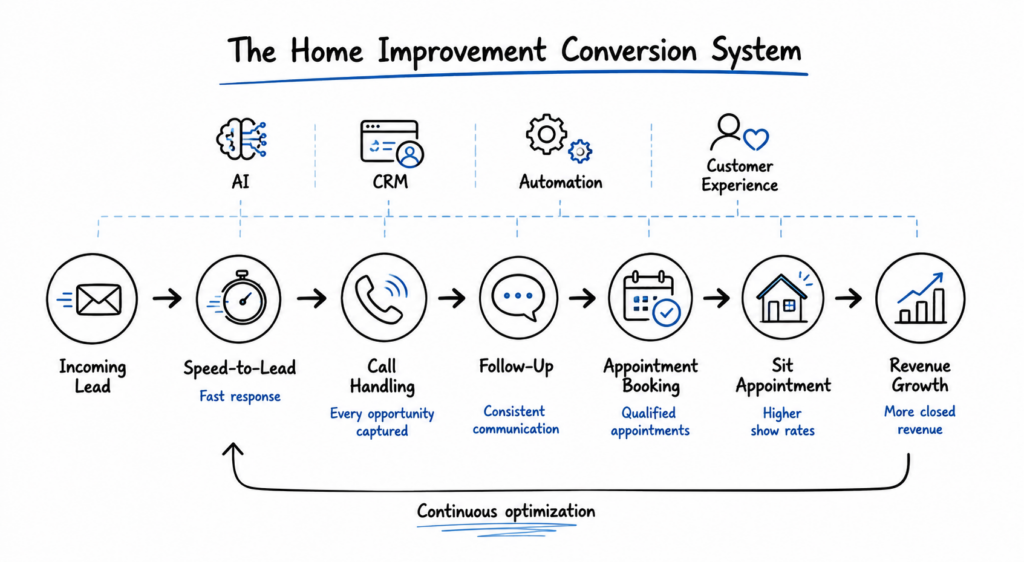
The companies creating the strongest long-term performance are no longer focused only on generating more demand. They are improving responsiveness, reducing operational friction, integrating technology more effectively, and building conversion systems that support the full customer journey.
As AI adoption accelerates and the market becomes more complex, the gap between companies will not be defined by who has the most tools.
It will be defined by who can execute most consistently across the entire revenue process.